

Contrasting evidence for corticosteroid treatment for coronavirus-induced cytokine storm

Hong Kong Med J 2020 Jun;26(3):269–71  |  Epub 5 Jun 2020
Hong Kong Academy of Medicine. CC BY-NC-ND 4.0
 
LETTER TO THE EDITOR
Contrasting evidence for corticosteroid treatment for coronavirus-induced cytokine storm
Karen KY Leung, MB, BS, MRCPCH1; KL Hon, MB, BS, MD1; SY Qian, MD2; Frankie WT Cheng, MB, ChB, MD1
1 Department of Paediatrics and Adolescent Medicine, The Hong Kong Children’s Hospital, Hong Kong
2 Pediatric Intensive Care Unit, Beijing Children’s Hospital, Capital Medical University, National Center for Children’s Health, China
 
Corresponding author: Dr KL Hon (ehon@hotmail.com)
 
 Full paper in PDF
 
To the Editor—Two recent articles concerning corticosteroid usage in the coronavirus disease 2019 (COVID-19) pandemic provide opposing evidence and run the risk of muddying the waters on this controversial yet important topic.1 2 On the one hand, Russell et al1 tabulated a number of mainly observational clinical studies cautioning more harm than benefit with corticosteroid usage. On the other hand, Shang et al,2 acknowledging that existing evidence is inconclusive at best, referenced recommendations by Chinese physicians with frontline clinical experiences of COVID-19 who advocate short courses of corticosteroids at low-to-moderate doses for more severe disease.
 
In clinical settings, physicians tend to use corticosteroids only for treating critically ill patients. Therefore, selection bias and confounders in observational studies might contribute to any observed increased mortality in patient groups treated with corticosteroids. The papers cited by Russell et al1 omit to address coronavirus mortality, and the strength of the evidence presented does not support the certainty of the authors’ conclusions (Table).
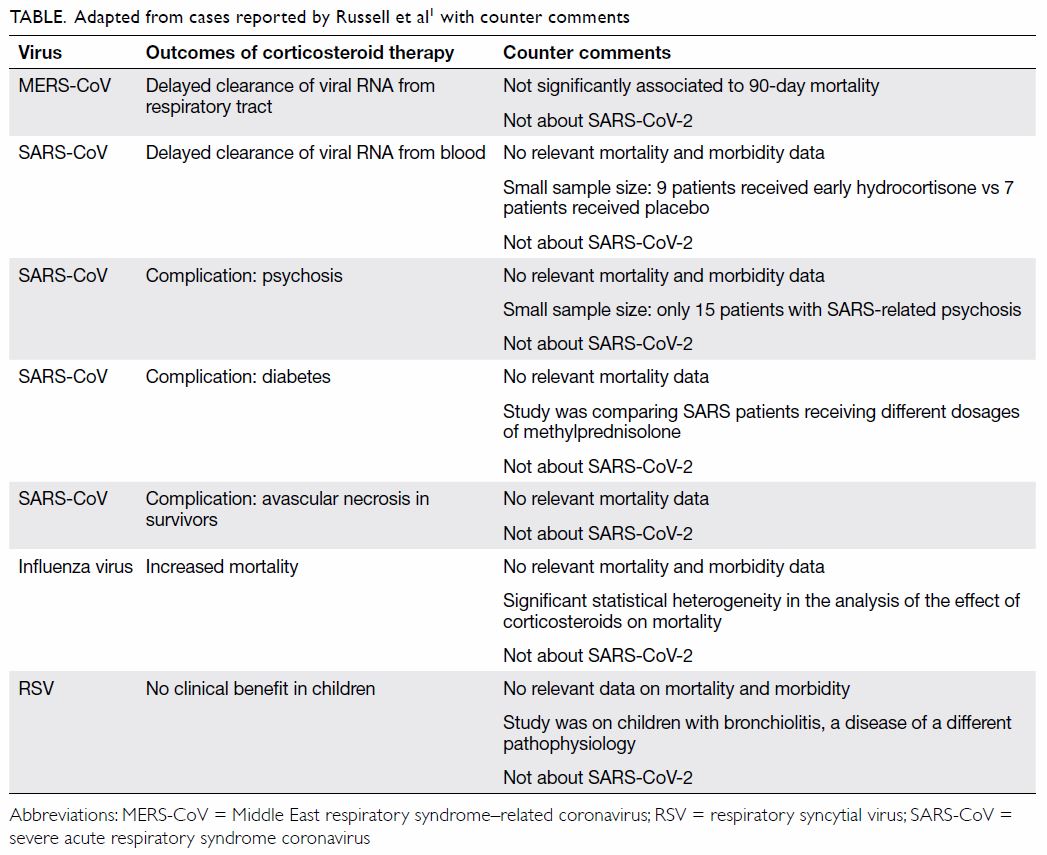
 

Table. Adapted from cases reported by Russell et al1 with counter comments
 
Similar to respiratory viral diseases such as the seasonal influenza, two categories of people seem susceptible to die from COVID-19: older adults, especially those with chronic disease or other co-morbidities, and seemingly healthy adults with exacerbated autoinflammatory syndrome termed the cytokine storm syndromes.3 4 5 On the contrary, children and infants seem to survive epidemics of coronavirus infections with very mild disease.6
 
We acknowledge the potential risks associated with high-dose corticosteroids in treating COVID-19 pneumonia, and agree that corticosteroid usage should be avoided if there are other efficacious anti-inflammatory immunomodulating medications against the cytokine storm, such as intravenous immunoglobulin, interleukin-1 inhibitors, interleukin-6 inhibitors, and Janus kinase inhibitors.4 However, on the basis of recommendations by frontline Chinese physicians and local clinical experience during the severe acute respiratory syndrome epidemic, a short course of corticosteroids at low-to-moderate dose is probably justifiable for critically ill patients with hyperinflammation.7 8 Chinese researchers are running a prospective randomised controlled trial to review the efficacy and safety of corticosteroids.9 Until further evidence becomes available, whether to use corticosteroids or not remains controversial.
 
Author contributions
All authors contributed to the concept of the study, acquisition and analysis of the data, drafting of the manuscript, and critical revision of the manuscript for important intellectual content. All authors had full access to the data, contributed to the study, approved the final version for publication, and take responsibility for its accuracy and integrity.
 
Conflicts of interest
The authors have no conflicts of interest to disclose.
 
Funding/support
This letter received no specific grant from any funding agency in the public, commercial, or not-for-profit sectors.
 
References
1. Russell CD, Millar JE, Baillie JK. Clinical evidence does not support corticosteroid treatment for 2019-nCoV lung injury. Lancet 2020;395:473-5. Crossref
2. Shang L, Zhao J, Hu Y, Du R, Cao B. On the use of corticosteroids for 2019-nCoV pneumonia. Lancet 2020;395:683-4. Crossref
3. Novel Coronavirus Pneumonia Emergency Response Epidemiology Team. The epidemiological characteristics of an outbreak of 2019 novel coronavirus diseases (COVID-19) in China [in Chinese]. Zhonghua Liu Xing Bing Xue Za Zhi 2020;41:145-51.
4. Mehta P, McAuley DF, Brown M, Sanchez E, Tattersall RS, Manson JJ, et al. COVID-19: consider cytokine storm syndromes and immunosuppression. Lancet 2020;395:1033-4. Crossref
5. Ng PC, Lam CW, Li AM, Wong CK, Cheng FW, Leung TF, et al. Inflammatory cytokine profile in children with severe acute respiratory syndrome. Pediatrics 2004;113:e7-14. Crossref
6. Hon KL, Leung CW, Cheng WT, Chan PK, Chu WC, Kwan YW, et al. Clinical presentations and outcome of severe acute respiratory syndrome in children. Lancet 2003;361:1701-3. Crossref
7. Zhao JP, Hu Y, Du RH, Chen ZS, Jin Y, Zhou M, et al. Expert consensus on the use of corticosteroid in patients with 2019-nCoV pneumonia [in Chinese]. Zhonghua Jie He He Hu Xi Za Zhi 2020;43:183-4.
8. Yam LY, Lau AC, Lai FY, Shung E, Chan J, Wong V, et al. Corticosteroid treatment of severe acute respiratory syndrome in Hong Kong. J Infect 2007;54:28-39. Crossref
9. US National Library of Medicine, US Government. Efficacy and Safety of Corticosteroids in COVID-19. Available from: https://clinicaltrials.gov/ct2/show/NCT04273321. Accessed 24 Mar 2020.

Workflow updates to maintain clinical services and reduce utilisation of personal protective equipment during the COVID-19 outbreak

Hong Kong Med J 2020 Jun;26(3):263–4  |  Epub 5 Jun 2020
Hong Kong Academy of Medicine. CC BY-NC-ND 4.0
 
LETTER TO THE EDITOR
Workflow updates to maintain clinical services and reduce utilisation of personal protective equipment during the COVID-19 outbreak
Ken YT Lee, PhD1; Aggie WS Kwan, MPH1; TL Que, MB, BS, FHKAM (Pathology)2; Mandy MY Mak, MSc1
1 Department of Physiotherapy, Tuen Mun Hospital, Hong Kong
2 Department of Clinical Pathology, Tuen Mun Hospital, Hong Kong
 
Corresponding author: Dr Ken YT Lee (physioken@yahoo.com.hk)
 
 Full paper in PDF
 
To the Editor—In a general hospital, there are many clinical procedures involving aerosol-generating procedures (AGPs), such as bronchoscopy and other specific procedures involving airway care, that can induce the production of aerosols of various sizes, including droplet nuclei.1 According to the latest guidelines from the Centre for Health Protection of the Hong Kong SAR Government, the recommended personal protective equipment (PPE) for performing AGPs includes N95 respirator, eye protection, gown, gloves, and cap (optional).2 However, there was a severe and mounting disruption to the global supply of PPE amid the outbreak of coronavirus disease 2019 (COVID-19). In response, the Hospital Authority adjusted public hospital non-emergency services and non-essential services to focus manpower and resources.3 Reducing utilisation of PPE in various clinical services has become an issue of current concern at frontline and management levels.4 5
 
Physiotherapists often perform AGPs such as open suctioning of respiratory tract (including tracheostomy care). In the Physiotherapy Department of Tuen Mun Hospital, the workflow of chest physiotherapy service was reviewed and analysed to explore the possibility of AGPs being grouped and handled by a designated team of physiotherapists, and the service delivery process of chest physiotherapy was then re-designed. A designated AGP team was established in which a group of physiotherapists (8 in total, on rotation) solely delivering chest physiotherapy involving AGPs. The workload for the AGP team was centralised and managed with extended working hours to maximise the use of every N95 respirator. To facilitate the implementation of the new workflow and compliance of infection control measures, a patient care assistant was assigned to assist the physiotherapist in logistics and patient preparation prior to and after the treatment, to maximise work efficiency. Additional training was provided to the patient care assistant to enhance their competency in infection control measures. The patient care assistant also helped to ensure proper gowning procedures of the physiotherapist. The changes in workflow were well communicated and supported by all staff. The AGP team using the new workflow have been observed by the consultant microbiologist and the cluster infection control officer, and they have found that the new workflow fulfils the updated requirements of infection control.
 
Since implementing the new workflow in February 2020, consumption of PPE in the Physiotherapy Department has decreased substantially. The usage of N95 respirators decreased from approximately 60 pieces to eight pieces daily (>80% reduction), resulting in saving >1000 N95 respirators per month. Most importantly, such administrative change of workflow neither sacrificed the clinical service provision nor the occupational safety in performing high-risk AGPs. In addition to chest physiotherapy, the above measures may also be applicable to other clinical procedures involving AGP such as elective endotracheal intubation, bronchoscopy, and upper airway endoscopy.
 
Author contributions
All authors contributed to the concept of the study, acquisition and analysis of the data, drafting of the manuscript, and critical revision of the manuscript for important intellectual content. All authors had full access to the data, contributed to the study, approved the final version for publication, and take responsibility for its accuracy and integrity.
 
Conflicts of interest
All authors have disclosed no conflicts of interest.
 
Funding/support
This letter received no specific grant from any funding agency in the public, commercial, or not-for-profit sectors.
 
References
1. World Health Organization. Infection prevention and control of epidemic- and pandemic-prone acute respiratory diseases in health care. Available from: https://www.who.int/csr/resources/publications/WHO_CD_EPR_2007_6/en/. Accessed 19 Mar 2020.
2. Centre for Health Protection, Department of Health, Hong Kong SAR Government. Recommended personal protective equipment (PPE) in hospitals/clinics under serious/emergency response level coronavirus disease (COVID-19). Available from: https://www.chp.gov.hk/files/pdf/recommended_ppe_for_nid_eng.pdf. Accessed 19 Mar 2020.
3. Hong Kong SAR Government. HA adjusts service provision to focus on combatting epidemic. Available from: https://www.info.gov.hk/gia/general/202002/10/P2020021000711.htm. Accessed 19 Mar 2020.
4. Hong Kong SAR Government. Protective gear supply ensured. Available from: https://www.news.gov.hk/eng/2020/03/20200313/20200313_180244_445.html. Accessed 19 Mar 2020.
5. Wong DH, Tang EW, Njo A, et al. Risk stratification protocol to reduce consumption of personal protective equipment for emergency surgeries during COVID-19 pandemic. Hong Kong Med J 2020 May 5. Epub ahead of print Crossref

Pages