

Hong Kong Med J 2025;31:Epub 5 Dec 2025
© Hong Kong Academy of Medicine. CC BY-NC-ND 4.0
EDITORIAL
Establishing the Jockey Club Institute for Medical Education and Development (JCIMED): advancing postgraduate medical education in Hong Kong
HY So, FHKAM (Anaesthesiology)1; Albert KM Chan, FHKAM (Anaesthesiology)2; Abraham KC Wai, FHKAM (Emergency Medicine)2; Carmen KM Lam, FHKAM (Anaesthesiology)2; CT Lui, FHKAM (Emergency Medicine)2; YF Choi, FHKAM (Emergency Medicine), MSc Clin Educ (Edin)1; PT Chan, FHKAM (Orthopaedic Surgery)1; Lawrence CN Chan, FHKAM (Paediatrics)1; Benny CP Cheng, FHKAM (Anaesthesiology)2; Clement CY Tham, FHKAM (Ophthalmology), FCOphth (HK)1; Philip KT Li, FHKAM (Medicine), DSc (HK)1
1 Hong Kong Academy of Medicine, Hong Kong SAR, China
2 The Jockey Club Institute for Medical Education and Development, Hong Kong SAR, China
Corresponding author: Dr Benny CP Cheng (cpcheng@hkam.org.hk)
 Full paper in PDF
Introduction
Building on the solid foundation laid by the Hong
Kong Jockey Club Innovative Learning Centre for
Medicine (HKJC ILCM) under the Hong Kong
Academy of Medicine (HKAM), the Jockey Club
Institute for Medical Education and Development
(JCIMED; https://jcimed.hkam.org.hk/) represents
the next evolution in postgraduate medical
education in Hong Kong. This article outlines the
establishment of JCIMED as a natural progression
of ILCM’s mission, aiming to promote competency-based
medical education (CBME) by supporting the
development of multiple competencies, integrating
innovative learning technologies, and advancing
educational strategies.
In a previous article, we documented the
transformative role that the HKJC ILCM has
played in shaping Hong Kong’s healthcare training
landscape.1 As a direct extension of this legacy,
JCIMED will continue to support the Academy and
its sister Colleges in delivering postgraduate medical
education that ensures high-quality patient care. By
integrating emerging medical practices, cutting-edge
technologies, and forward-thinking educational
strategies, JCIMED will set new benchmarks for
medical education in Hong Kong.
The establishment of JCIMED is rooted in the
outcomes of the 2023 HKAM Tripartite Medical
Education Conference, held during the Academy’s
30th anniversary celebrations. This pivotal event,
alongside a strategic planning retreat, helped
define the Academy’s vision for postgraduate
medical education in Hong Kong. The findings
were encapsulated in the HKAM position paper on
postgraduate medical education, which informed
the Hong Kong Jockey Club Charities Trust’s
funding proposal for JCIMED.2 We are grateful to
Professor Gilberto Leung and Professor Philip Li, whose leadership was instrumental in advancing
this initiative.
To provide context for JCIMED within the
global landscape of medical education centres,
we reviewed similar institutions worldwide. Our
search prioritised centres focused primarily on
postgraduate medical education, particularly those
advancing CBME, integrating innovative technology,
and supporting research. As an outcomes-oriented
approach, CBME prepares doctors for real-world
practice by organising training around essential
competencies. Unlike traditional models based
on time and examinations, CBME emphasises
demonstrated ability, personalised learning, and
ongoing feedback. It fosters communication,
professionalism, and teamwork—skills critical in
modern healthcare.3 Adopting CBME as a core
strategy, JCIMED ensures postgraduate training
aligns with evolving patient and societal needs.
While some centres also serve undergraduates,
we included only those dedicated to postgraduate
training. A comparison of key centres, highlighting
their unique contributions and alignment with
JCIMED’s mission to advance postgraduate medical
expertise in Hong Kong, is summarised in the Table.
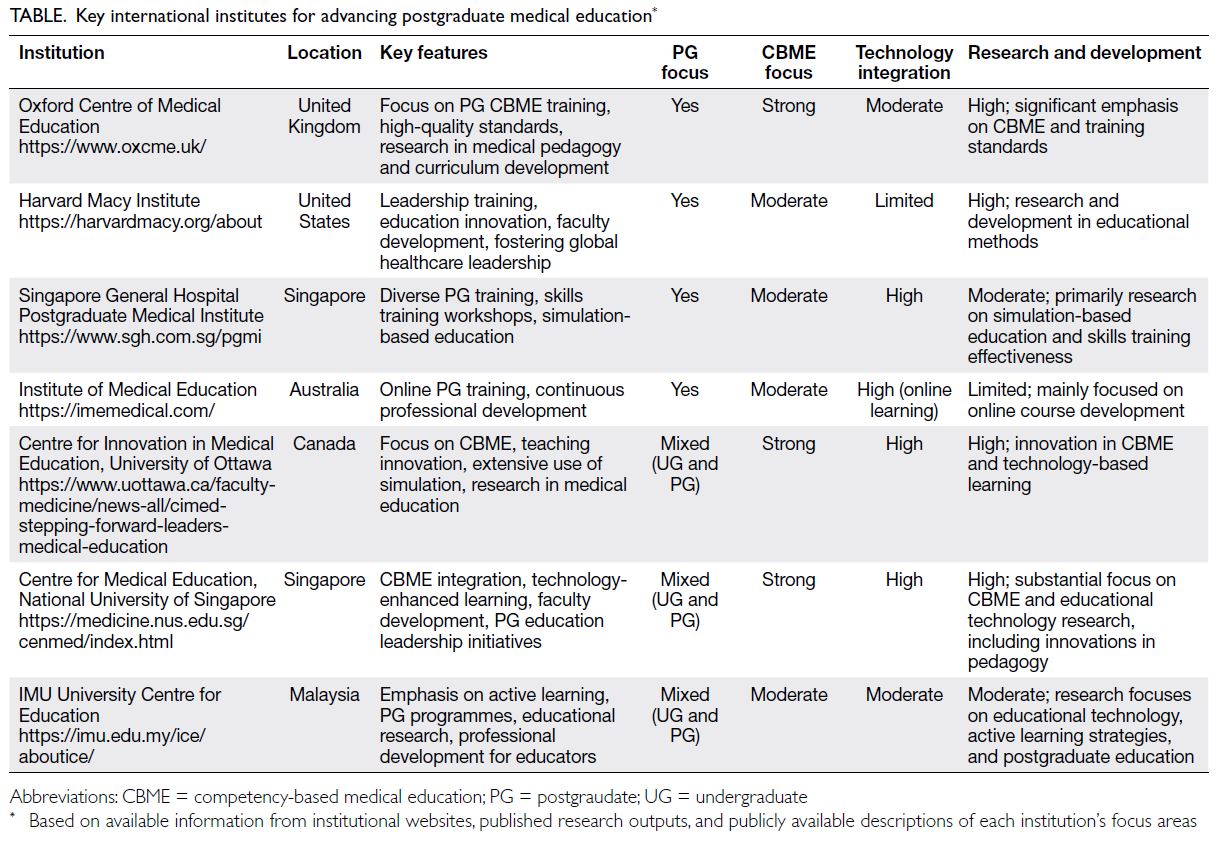
Table. Key international institutes for advancing postgraduate medical education
Structure of the institute
Established on 1 November 2024, JCIMED operates
under a governance framework designed to ensure
innovation, accountability, and alignment with
the broader educational goals of the HKAM.
Chaired by the Honorary Director, the Operation
Committee provides strategic oversight for JCIMED.
This committee reports to the JCIMED Steering
Committee, chaired by the Vice-President (Education
and Examinations) of HKAM, ensuring alignment
with HKAM’s educational objectives. Ultimately, the
Steering Committee reports to the HKAM Council, which governs postgraduate medical education at the highest level.
A dedicated team of educational experts
supports JCIMED. An Educationist, assisted by three
Assistant Educationists, advises both the HKAM
Education Committee and JCIMED, ensuring that
the latest trends in pedagogy and medical education
are integrated into our programmes.
The JCIMED’s operations are carried out
through four key subcommittees4 aligned with its
strategic goals:
- Training and Faculty Development Subcommittee: Focuses on enhancing medical educators’ skills through targeted programmes and workshops.
- eLearning and Technology Subcommittee: Responsible for integrating digital innovations such as artificial intelligence (AI), extended reality (XR), and e-learning platforms into postgraduate training.
- Quality Management Subcommittee: Ensures all educational initiatives meet rigorous quality standards and drive continuous improvement.
- Research Subcommittee: Advances scholarly inquiry in medical education and fosters an evidence-based approach to learning and development.
Driving the institute forward
With this robust structure in place, JCIMED is now
positioned to execute its strategic vision through a
comprehensive 5-year action plan. The plan centres
on three interconnected themes, reflecting JCIMED’s
commitment to promoting CBME by supporting
the development of multiple competencies,
integrating technology, and advancing innovation in
postgraduate medical education.
Fostering multiple competencies for
tomorrow’s healthcare workforce
The JCIMED’s core mission is to prepare healthcare
professionals to meet the challenges of a rapidly
evolving medical landscape. Among the core
competencies, professionalism remains a key
competency and requires ongoing cultivation. To
this end, JCIMED will partner with the HKAM
Professionalism and Ethics Committee to deliver programmes that emphasise the application of
professionalism in daily practice.
Recognising the growing importance of
handheld ultrasound as a bedside diagnostic tool,
JCIMED will lead initiatives to ensure all specialists
are proficient in this essential skill. By offering
comprehensive training and access to advanced
ultrasound devices, JCIMED aims to revolutionise
patient care. Additionally, with the rise of precision
medicine, JCIMED will collaborate with specialties
including, but not limited to, paediatrics, internal
medicine, and pathology to provide training in
genetics and genomics, preparing practitioners for
the expanding role of these fields.
Harnessing the power of learning technology
A steadfast commitment to excellence in simulation-based
medical education5 and e-learning reflects
JCIMED’s dedication to staying at the forefront
of educational technology. We will continue to
strengthen these core areas while expanding our
impact through the integration of cutting-edge
technologies such as AI and XR, to further enhance
learning outcomes and meet the evolving needs of
healthcare. Personalised learning experiences will be
made possible through AI, which tailors content to
individual needs and optimises performance, while
XR will create immersive environments that simulate
complex clinical scenarios. These tools will provide
trainees with a level of preparedness previously
unattainable in traditional educational settings.6
Our forward-thinking approach ensures
JCIMED remains at the cutting edge of medical
education, continually integrating the latest and
most effective technologies into our programmes to
enhance the learning experience.
Driving educational transformation
Advancing CBME by embedding it across all
postgraduate training programmes remains a
central commitment of JCIMED.2 3 A cornerstone
of CBME, workplace-based assessment provides
timely feedback on clinical performance.7 However,
its labour-intensive nature has often hindered
implementation. To address this, JCIMED is
developing a mobile app to streamline workplace-based
assessment processes. The app will alleviate
the documentation burden, ensuring assessments are
timely, formative, and learner-centred, supporting
both trainers and trainees in fostering a culture of
continuous feedback and growth.
At the same time, JCIMED is committed to
strengthening faculty development. We will offer
a comprehensive suite of programmes tailored for
trainers, supervisors, examiners, and educational
leaders.8 These initiatives will ensure that clinical
educators are well-equipped to fulfil the promise of CBME, preparing future medical professionals to
exceed the standards of tomorrow.
Conclusion
The establishment of JCIMED marks a significant
step forward in postgraduate medical education in
Hong Kong. By integrating CBME, embracing next-generation
technologies, and adopting innovative
educational approaches, JCIMED will help transform
healthcare education in Hong Kong and the Greater
Bay Area. Building on the legacy of the HKJC ILCM,
JCIMED reaffirms our commitment to equipping
medical professionals with the competencies needed
to excel in today’s healthcare setting.
Author contributions
Concept or design: HY So.
Acquisition of data: HY So.
Analysis or interpretation of data: All authors.
Drafting of the manuscript: HY So.
Critical revision of the manuscript for important intellectual content: All authors.
Acquisition of data: HY So.
Analysis or interpretation of data: All authors.
Drafting of the manuscript: HY So.
Critical revision of the manuscript for important intellectual content: All authors.
All authors contributed to the editorial, approved the final version for publication, and take responsibility for its accuracy and integrity.
Conflicts of interest
All authors have disclosed no conflicts of interest.
Acknowledgement
The authors would like to express their gratitude to the Hong
Kong Jockey Club Charities Trust for funding this initiative.
Funding/support
This editorial received no specific grant from any funding agency in the public, commercial, or not-for-profit sectors.
References
1. Chen PP, So HY, Lo JS, Cheng BC. Modernising
postgraduate medical education: evolving roles of The
Hong Kong Jockey Club Innovative Learning Centre for
Medicine in the Hong Kong Academy of Medicine. Hong
Kong Med J 2023;29:480-3. Crossref
2. So HY, Li PK, Lai PB, et al. Hong Kong Academy of Medicine
position paper on postgraduate medical education 2023.
Hong Kong Med J 2023;29:448-52. Crossref
3. So HY. Competency-based medical education:
transforming medical education for the 21st century
healthcare system. academyfocus April 2024: 4-5. Available
from: https://www.hkam.org.hk/sites/default/files/hkam-focus/202402/202402.html. Accessed 8 Dec 2024.
4. The Jockey Club Institute for Medical Education and
Development, Hong Kong Academy of Medicine. About
JCIMED. Governance. Available from: https://jcimed.hkam.org.hk/en/governance. Accessed 8 Dec 2024.
5. So HY, Chen PP, Wong GK, Chan TT. Simulation in
medical education. J R Coll Physicians Edin 2019;49:52-7. Crossref
6. So HY. Technology, life-long learning and heutagogy. Hong
Kong J Emerg Med 2024;31:281-4. Crossref
7. So HY, Choi YF, Chan PT, Chan AK, Ng GW, Wong GK.
Workplace-based assessments: what, why, and how to
implement? Hong Kong Med J 2024;30:250-4. Crossref
8. So HY, Li PK, Cheng BC, Faculty Development
Workgroup, Hong Kong Jockey Club Innovative Learning
Centre for Medicine, Leung GK. Faculty development
for postgraduate medical education in Hong Kong. Hong
Kong Med J 2024;30:428-30. Crossref