
© Hong Kong Academy of Medicine. CC BY-NC-ND 4.0
REMINISCENCE: ARTEFACTS FROM THE HONG KONG MUSEUM OF MEDICAL SCIENCES
Professor Gerald Choa and the Hong Kong
Museum of Medical Sciences
TW Wong, FHKAM (Emergency Medicine)
Member, Education and Research Committee, Hong Kong Museum of Medical Sciences Society
 Full paper in PDF
In 2026, the Hong Kong Museum of Medical Sciences
(HKMMS) will celebrate its 30th anniversary.1
The building that houses the Museum, namely the
Bacteriological Institute, will have stood for 120
years.2 The Bacteriological Institute was built in 1906
in the aftermath of the bubonic plague epidemic that
ravaged Hong Kong.2 For many years, it served as the
public health laboratory and vaccine producer for the
Colony, safeguarding the health of the population.2
Its name was changed to the Pathological Institute
after the Second World War, and it continued to play
an important role as the main government laboratory
until 1960, when a new facility was established in
the Sai Ying Pun Jockey Club Polyclinic.3 The Old
Pathological Institute continued vaccine production until the 1970s, after which it became a government
store.4 It was given a new lease of life in 1990, when
it was declared a protected monument under the
Antiquities and Monuments Ordinance.2 4 The Hong
Kong College of Pathologists led the bid for the site
to be run as a medical museum.1 A Museum Steering
Committee was formed in 1992 to submit proposals
to the Government, and Professor Gerald Choa
volunteered to join the Committee. The bid was
successful and the HKMMS Society was formed in
1995 to manage the future museum, with Professor
Choa as its founding Chairman.5 The Museum was
opened on 22 March 1996 by Mr Christopher Patten,
the then Governor of Hong Kong (Fig 1).
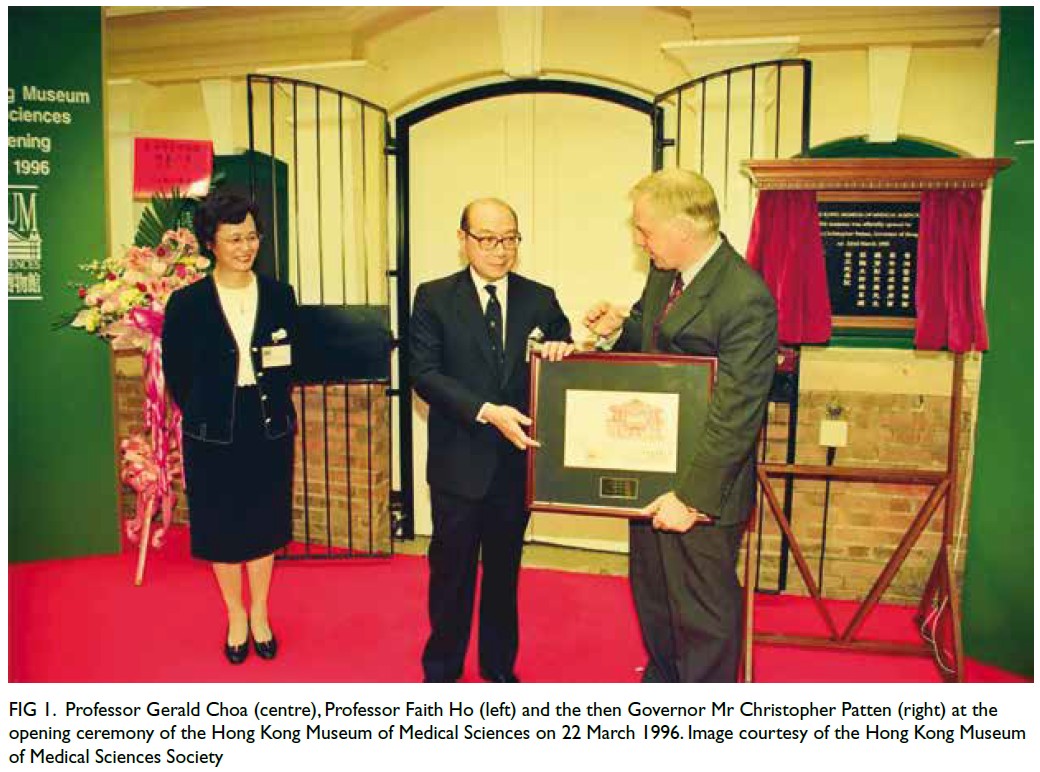
Figure 1. Professor Gerald Choa (centre), Professor Faith Ho (left) and the then Governor Mr Christopher Patten (right) at the opening ceremony of the Hong Kong Museum of Medical Sciences on 22 March 1996. Image courtesy of the Hong Kong Museum of Medical Sciences Society
Professor Gerald Choa (1921-2001) was a distinguished physician whose achievements as
a clinician, administrator and educator are well
recognised.6 7 He was the first Chinese doctor to be
appointed to the rank of Specialist in Medicine by
the Government in 1956.5 He became the Director
of Medical and Health Services in 1970 and helped
to modernise the healthcare system.6 After retiring
from Government service in 1976, he took up the
challenge of establishing a new medical faculty at
The Chinese University of Hong Kong, serving as its
founding Dean.6 Less well known were his interests in, and contributions to, the scholarship of medical
history of Hong Kong.
Professor Choa’s interests in history appears
to have developed early. From the 1960s, he was a
life member of the Hong Kong Branch of the Royal
Asiatic Society. At a symposium organised by the
Society in 1966, he delivered two lectures on Chinese
traditional medicine8 and Chinese concepts of food and diet.9 He also wrote an article on the history of
medicine in Hong Kong for the first edition of The
Medical Directory of Hong Kong (1970), probably the
first comprehensive account of the subject.10 As head
of the Medical and Health Department, he had the
rare opportunity to access a bound volume of reports
handwritten by the Colonial Surgeons between 1845
and 1859. Despite his busy schedule, he published a
book in 1981 titled The Life and Times of Sir Kai Ho
Kai.11 Dr Kai Ho (1859-1914) was the first Chinese
graduate of the medical school of the University of
Aberdeen, graduating in 1879. He served as a member
of the Legislative Council from 1890 to 1914 and was
a leader of the local Chinese community. Although
he did not practise medicine in Hong Kong, he was
instrumental in many medical developments of his
time. He donated funds to the London Missionary
Society to build the Alice Memorial Hospital in
1887, named in memory of his wife, Alice Walkden,
who had died a few years earlier. He was one of the
founders of the Hong Kong College of Medicine for
Chinese, which used the Alice Memorial Hospital
as its teaching hospital, and he also served as the
founding chairman of Kwong Wah Hospital, which
opened in 1911. Professor Choa’s work on Dr Kai
Ho was hailed as an important contribution to local
history, and a second edition was published in 2000.
His second book titled “Heal the Sick” was Their
Motto: The Protestant Medical Missionaries in China
was published in 1990 and recounted the work of
Protestant medical missionaries in China from 1834
to 1949.12 It details their role in introducing Western
medical education to China and Hong Kong. After
retiring from The Chinese University of Hong Kong
in 1986, he wrote further on the history of medical
education in Hong Kong13 and on the influence of one of its most distinguished students—Dr Sun Yat-sen.14
Professor Choa made an important contribution to our understanding of the early phase
of the 1894 plague epidemic in an article based on Dr
James Lowson’s diary.15 Dr Lowson was the Deputy
Medical Superintendent at the Government Civil
Hospital and was directly involved in managing
plague patients during the epidemic. His diary
serves as a valuable primary source on the evolution
of events and the response to the outbreak (Fig 2).
The diary was preserved by his granddaughter, Mrs
FM Ashburner, who happened to read a newspaper
interview with Professor Faith Ho in 1993 about
the establishment of a new medical museum. She
donated a copy of the diary to the future museum,
where it remains one of its most valuable possessions.
In addition to detailing day-to-day events and the
measures taken, it records the diarist’s conflicts with
the authorities, information unlikely to appear in
official reports.
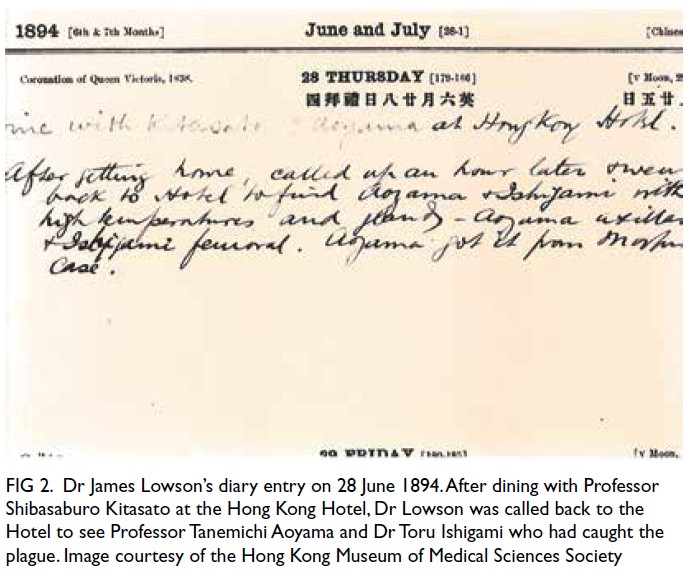
Figure 2. Dr James Lowson’s diary entry on 28 June 1894. After dining with Professor Shibasaburo Kitasato at the Hong Kong Hotel, Dr Lowson was called back to the Hotel to see Professor Tanemichi Aoyama and Dr Toru Ishigami who had caught the plague. Image courtesy of the Hong Kong Museum of Medical Sciences Society
As Chairman of the newly opened Medical
Museum, Professor Choa played a leading role in
educating the public about Hong Kong’s medical
history. Alice Ho Miu Ling Nethersole Hospital held
its 110th Anniversary Exhibition at the Museum in
1997. As part of the programme, Professor Choa
delivered a lecture titled History of Alice Ho Miu
Ling Nethersole Hospital and Hong Kong College of
Medicine. He handed over the baton to Dr Tak-fu
Tse in 1999 and passed away in 2001.
The Gerald Choa Memorial Fund of the
HKMMS Society was established in 2002 with
donations from Professor Choa’s family and friends
to support research into Hong Kong’s medical
history and related Museum publications. The first project was a book on the history of medicine in
Hong Kong, published in 2006 to coincide with the
10th anniversary of the HKMMS.16 It is dedicated to the memory of Professor Choa, who contributed
greatly to the scholarship in local medical history
and to the establishment of the Museum.
References
1. Hong Kong Museum of Medical Sciences. The Museum. Available from: https://www.hkmms.org.hk/en/about-us/the-museum/. Accessed 26 Mar 2026.
2. Hong Kong Museum of Medical Sciences. The Monument. Available from: https://www.hkmms.org.hk/en/about-us/the-monument/. Accessed 26 Mar 2026.
3. Ho FC. The period during the Japanese occupation (1942-1945) and post-war development. In: The Silent Protector—Hong Kong’s Bacteriological Institute, its History and Legacy (Revised 2nd Edition). Hong Kong: Hong Kong Museum of Medical Sciences; 2020: 76-89.
4. Antiquities and Monuments Office, Hong Kong SAR Government. Heritage sites. Declared Monuments in Hong Kong—Hong Kong Island. Old Pathological Institute, Caine Lane, Sheung Wan. Available from: https://www.amo.gov.hk/en/historic-buildings/monuments/hong-kong-island/monuments_41/index.html. Accessed 26 Mar 2026.
5. Ho FC. Development of the Old Pathological Institute into the Hong Kong Museum of Medical Sciences—preserving the legacy of the BI. In: The Silent Protector—Hong Kong’s Bacteriological Institute, its History and Legacy (Revised 2nd Edition). Hong Kong: Hong Kong Museum of Medical Sciences; 2020: 90-103.
6. Yu YL. Reminiscences of three former teachers: Prof AJS McFadzean, Dr Stephen Chang, and Prof Gerald Choa. Hong Kong Med J 2009;15:315-8.
7. Li AK. Eulogy for Professor Gerald Choa. Hong Kong College of Physicians Synapse 2002;Apr:19-21.
8. Choa G. Chinese traditional medicine and contemporary Hong Kong. In: Topley M (Ed). Some Traditional Chinese Ideas and Conceptions in Hong Kong Social Life Today: Week-end Symposium, October 1966. Hong Kong: Hong Kong Branch of the Royal Asiatic Society; 1967: 31-5.
9. Choa G. Some ideas concerning food and diet among Hong Kong Chinese. In: Topley M (Ed). Some Traditional Chinese Ideas and Conceptions in Hong Kong Social Life Today: Week-end Symposium, October 1966. Hong Kong: Hong Kong Branch of the Royal Asiatic Society; 1967: 54-9.
10. Choa GH. A history of medicine in Hong Kong. In: The Medical Directory of Hong Kong. Hong Kong: Federation of Medical Societies of Hong Kong; 1970: 11-26.
11. Choa GH. The Life and Times of Sir Kai Ho Kai: A Prominent Figure in Nineteenth-century Hong Kong. Hong Kong: The Chinese University Press; 1981.
12. Choa GH. “Heal the Sick” was Their Motto: The Protestant Medical Missionaries in China. Hong Kong: The Chinese University of Hong Kong Press; 1990.
13. Choa GH. A history of medical education in Hong Kong. Synapse 1994;Suppl 2:3-6.
14. Choa GH. Hong Kong, medicine and Sun Yat Sen. Hong Kong Pract 1992;14:2067-74.
15. Choa GH. The Lowson diary: a record of the early phase of the Hong Kong bubonic plague 1894. J Hong Kong Branch R Asiat Soc 1993;33:129-45.
16. Hong Kong Museum of Medical Sciences Society. Plague, SARS and the Story of Medicine in Hong Kong. Hong Kong: Hong Kong University Press; 2006.