

© Hong Kong Academy of Medicine. CC BY-NC-ND 4.0
HEALTHCARE FOR SOCIETY
Reflecting on the past and looking to the future: an interview with Mr Thomas Chung-ching Chan, JP
Colson Yang, Nicole Su
Year 6, The Chinese University of Hong Kong, Hong Kong SAR, China
 Full paper in PDF
With advances in technologies such as artificial
intelligence, alongside an ever-changing global
political climate, the public health sector faces more
challenges—and opportunities—than ever before.
Vaccine hesitancy and health misinformation are
rife in today’s digital age, while the rise of artificial
intelligence technologies and big data opens new
avenues for traditional Chinese medicine and its
integration into modern Western medicinal sciences.
These are among the issues reflected in the work
of Mr Thomas Chung-ching Chan, JP, Permanent
Secretary for Health at the Health Bureau. His more
than 34 years of experience as one of Hong Kong’s
public administrators have helped ensure that our
city upholds its standard of excellence in healthcare
and maintains its leadership role as a bridge between
Western and traditional Chinese medicine.
Mr Chan first joined the Government in 1991.
Prior to his appointment as Permanent Secretary
for Health, he held numerous posts, including
positions in the former Civil Service Branch; the
former Planning, Environment and Lands Branch;
the former City and New Territories Administration;
and the HKETO (Hong Kong Economic and Trade
Office). In the latter, he was posted to HKETO in
Geneva, which is the official representation of the
Hong Kong SAR of the People’s Republic of China
at the World Trade Organization. During this time,
Mr Chan gained unique insight into Hong Kong’s
strengths as a multicultural and multidimensional
city, and how best to leverage its position as a bridge
between East and West. Nevertheless, the longest
phase of his career—spanning 11 years—has been dedicated to the governance of health policy. He
served as Principal Assistant Secretary for Health,
Welfare and Food from 2006 to 2008, and Deputy
Secretary for Food and Health (Health) from 2008
to 2012, before re-joining the Health Bureau in 2020
as Director of Special Duties. He has since been
appointed as Permanent Secretary for Health. He
considers the central focus of his career to have been
closely tied to health, having been called upon to
assist during the 2009 swine influenza pandemic and
the more recent COVID-19. In his spare time, Mr
Chan keeps active through running, swimming and
hiking. He previously volunteered as a mini-rugby
coach, and has recently taken up sailing.
One of the highlights of Mr Chan’s career was
his contribution to tackling Hong Kong’s COVID-19
pandemic. His reflections on how the Government
managed the outbreak, what might have been done
differently, and the key takeaways offer valuable
insights for the management of future public health
crisis. According to Mr Chan, Hong Kong’s public
health challenges have long been intertwined with
the city’s development. The city has consistently
learnt from and adapted to past outbreaks, such as
the plague and cholera during the colonial era, and
the 2003 SARS (severe acute respiratory syndrome
coronavirus) epidemic. These experiences shaped
Hong Kong’s streetscape, building designs, sewage
systems and outbreak management protocols. Hong
Kong was not taken by surprise when coronavirus
first entered the community in 2020. The city was
prepared with lockdown protocols, social distancing
measures and a well-equipped health system to deal with an anticipated surge in cases. What did surprise
health experts, however, was the duration of the
pandemic. The outbreak was initially predicted to
last between 6 months and a year. When it persisted
for nearly 3 years, the greatest challenge became
balancing the city’s many competing needs and
priorities. Early control measures included the
closure of schools and tightening the city’s border
control. As the pandemic progressed, however, the
educational needs of the youth and the economic
imperative to fully reopen borders increased. One of
the most difficult tasks for public health officials was
reconciling these competing priorities.
Another challenge during the COVID-19
pandemic was the surge in vaccine hesitancy. Hong
Kong citizens were privileged to have access to both
inactivated and mRNA vaccines. Despite this, the
vaccine rollout was met with considerable public
scepticism, resulting in a slower initial uptake.
This was particularly problematic among the most
vulnerable groups, including children and older
adults, who had the lowest vaccination rates.1 Future
public health policies should incorporate measures
to address vaccine hesitancy, particularly in light of
the rise in online misinformation. Such measures
may include promoting evidence-based health
information through official channels.
More recently, Mr Chan has focused on
leveraging Hong Kong’s unique position as an
international city with strong connections to both
Chinese Mainland and the wider global professional
community. Hong Kong is well placed to serve
as a bridge for collaboration and the translation
of scientific research and innovation. With the
establishment of the Greater Bay Area International
Clinical Trial Institute, the city is ideally positioned
to facilitate collaboration between researchers as
well as research institutions in Hong Kong and the
Chinese Mainland in conducting clinical trials. In
addition, Mr Chan believes that Hong Kong has
significant potential to promote Chinese medicine
on a global scale, while working closely with the
sector to provide more comprehensive services to
local citizens and improve health outcomes. With
the first Chinese medicine hospital commenced
services, Hong Kong aims to deliver integrated
Chinese and Western medicine services, with
Chinese medicine playing a predominant role and in
collaboration with Western medicine practitioners
based at the hospital. Mr Chan also envisions that
this collaboration between Chinese and Western
medicine, together with the use of both English
and Chinese as medium of communication among
professionals, can enhance mutual understanding
within the medical community in Hong Kong and
internationally. One of the hospital’s new initiatives
is to develop a database on herbal-drug interactions, enabling Chinese and Western medicine to work synergistically and safely, and improving treatment
outcomes in conditions for which Western medicine
alone may not work best.
Having spent over one-third of his career
working in public health, Mr Chan expresses his
sincere appreciation to the healthcare professionals
in Hong Kong, who have always shown a high
standard of professionalism and dedication, even
in the most difficult times. Whether during the
COVID-19 pandemic or the more recent Tai Po
fire, Mr Chan has witnessed overwhelming support from professionals across sectors who volunteered
their time and expertise to assist affected citizens.
Working in healthcare policy has been all the more
rewarding for Mr Chan as he collaborates with these
dedicated individuals.
References
1. Centre for Health Protection, Department of Health, Hong
Kong SAR Government. Statistics on Government COVID-19
Vaccination Programme. Available from: https://www.chp.gov.hk/en/features/106989.html. Accessed 1 Mar 2026.
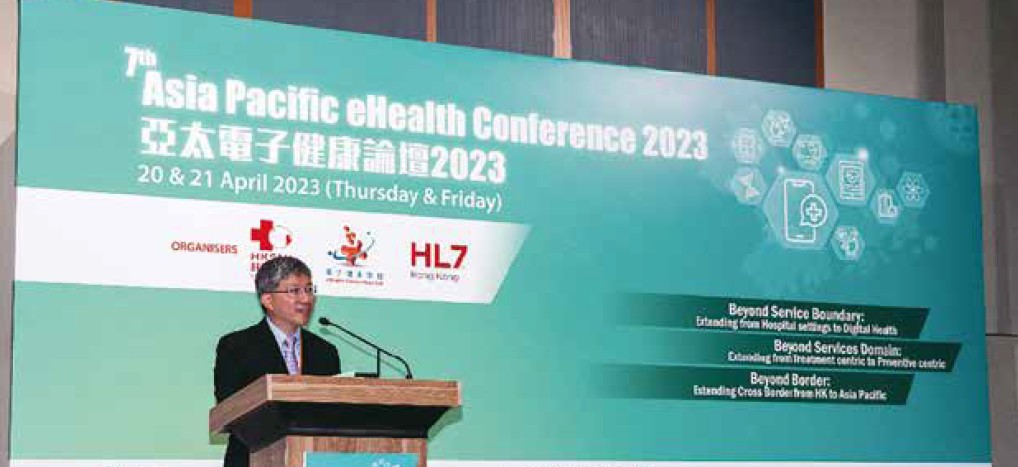
Mr Chan delivered the opening remarks at the 7th Asia-Pacific eHealth Conference at the Hong Kong Science Park on 20 April 2023
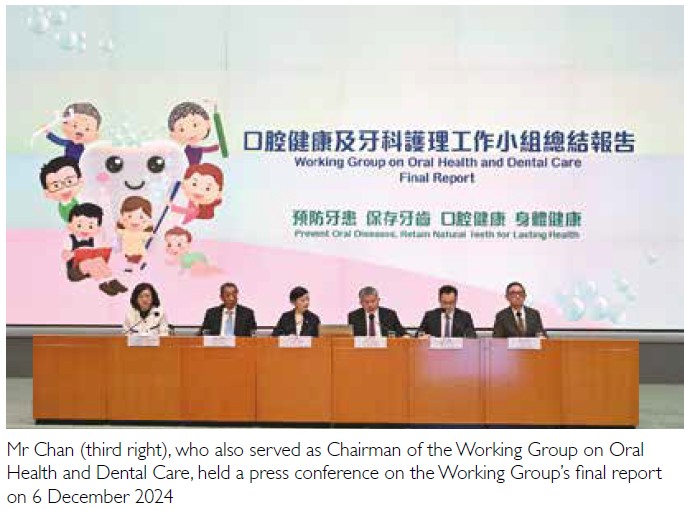
Mr Chan (third right), who also served as Chairman of the Working Group on Oral Health and Dental Care, held a press conference on the Working Group’s final report on 6 December 2024
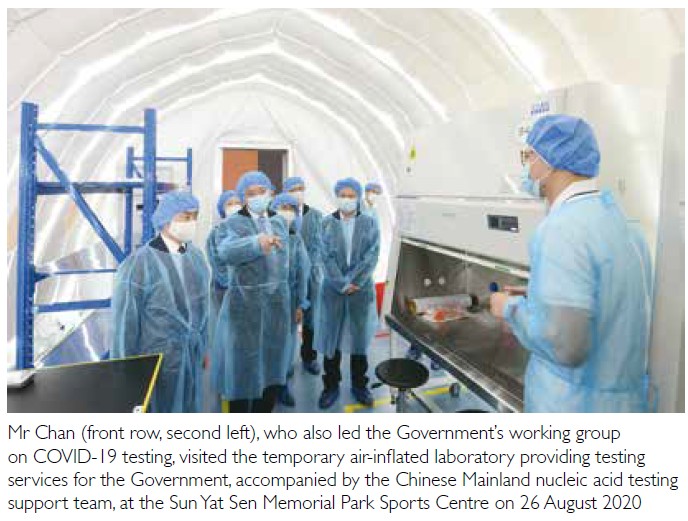
Mr Chan (front row, second left), who also led the Government’s working group on COVID-19 testing, visited the temporary air-inflated laboratory providing testing services for the Government, accompanied by the Chinese Mainland nucleic acid testing support team, at the Sun Yat Sen Memorial Park Sports Centre on 26 August 2020
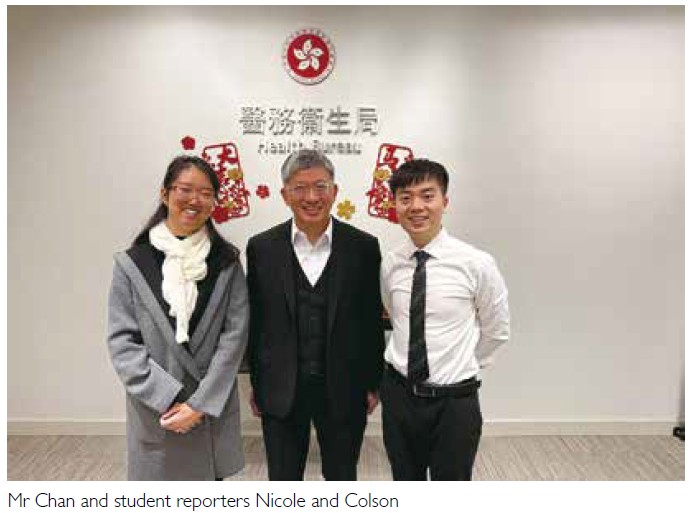
Mr Chan and student reporters Nicole and Colson