

© Hong Kong Academy of Medicine. CC BY-NC-ND 4.0
REMINISCENCE: ARTEFACTS FROM THE HONG KONG MUSEUM OF MEDICAL SCIENCES
The Guild of St Luke, St Cosmas and St Damian
Rebecca Yeung, FHKAM (Radiology)1; TW Wong, FHKAM (Emergency Medicine)2
1 Guest author, Education and Research Committee, Hong Kong Museum of Medical Sciences Society
2 Member, Education and Research Committee, Hong Kong Museum of Medical Sciences Society
 Full paper in PDF
The Catholic Church was established in Hong Kong
soon after the island was proclaimed a British colony.
St Francis Hospital was built in 1852 in Wanchai, and
in 1869 the Canossian sisters took over its operation.
It was replaced by the Canossa Hospital on Old Peak
Road in 1959. St Paul’s Hospital also began in Wanchai
around 1894 before relocating to its present site in
Causeway Bay in around 1918. Two more Catholic
hospitals—St Teresa’s Hospital and Precious Blood
Hospital—were opened before the Second World
War. More Catholic hospitals, including Our Lady
of Maryknoll Hospital and Caritas Medical Centre,
were built in the 1960s to meet the unmet demand
created by a rapidly increasing population.1 By the
mid-1960s, various Catholic bodies operated 32
clinics serving the poor.2 Some of these clinics were
served by local Catholic doctors who worked pro bono.
The Guild of St Luke, St Cosmas and St Damian
Hong Kong (the Guild) is an organisation of Catholic
doctors in Hong Kong. Its story began in 1953. In
March 1953, a number of Catholic doctors were
invited to a 3-day retreat at Ricci Hall of The University
of Hong Kong. During an after-dinner discussion, it
was decided to establish a Catholic doctors’ guild.
They wrote to Bishop Lawrence Bianchi who granted
approval.3 4 The Guild was formed on 28 May 1953
to promote mutual welfare—both professional and
spiritual—among Catholic doctors, and to provide
opportunities and facilities for social gatherings and
medical discussions, especially in relation to the
principles of Catholic medical ethics.4
The Guild was named after the patron saints
of the medical profession: St Luke, St Cosmas and
St Damian. They were all doctors. St Cosmas and
St Damian were twin brothers and early Christian
martyrs, known for providing free medical services.
St Luke is the evangelist who wrote the Gospel of
Luke.
The Jesuit Fathers, founders of Ricci Hall, were
instrumental in the establishment of the Guild. Fr
Fergus Cronin, warden of Ricci Hall from 1947 to
1955, was a strong advocate for its founding and
served as its spiritual advisor from the beginning
until 1980. He was succeeded by Fr John Russell and
later by Fr Robert Ng (from 2008 to the present).
Although the Guild does not have great
influence on local medical developments, some
of its founding members have made significant
contributions. More importantly, they are living
testimony to the Catholic faith that advocates for
serving our poorer brothers and sisters.
Among the founding members were two
Columban sisters, Sr Mary Aquinas Monaghan and
Sr Mary Gabriel O’Mahoney, fondly remembered
as the Guardian Angels of the Guild. They played a
pivotal role in the fight against tuberculosis in Hong
Kong and were highly respected for their decades of
service at the Ruttonjee Sanatorium. They provided
invaluable support to the Guild in both spiritual and
ethical matters. Apart from her medical work, Sr
Aquinas helped drug addicts from the early 1960s
and chaired SARDA (The Society for the Aid and
Rehabilitation of Drug Abusers) from 1981 until her
death in 1985.5 Sr Gabriel was a pioneer in hospice
care in Hong Kong, showing great compassion for
dying patients and their families.6
Prof Gerald Choa was one of the founders
of the Guild, serving as Master from 1954 to 1955
and making significant contributions to the medical
profession in Hong Kong. He was Director of
Medical and Health Services and the founding Dean
of the Faculty of Medicine at The Chinese University
of Hong Kong. After retiring from the University, he
volunteered to care for patients at the Ta Kwu Ling
clinics run by the Columban Sisters.7
Prof Rosie Young graduated from The
University of Hong Kong in 1953, the same year the
Guild was established, and she remembers Prof Choa
well. He was her mentor and supervisor during her
internship at Queen Mary Hospital, and was the one
introduced her to the Guild.8 She remains a devoted
member and has fond memories of Fr Cronin whom
she admired and trusted implicitly.
Prof Harry Fang, a past Master of the Guild, is
widely known as the ‘Father of Rehabilitation’ in Asia.
He was a long-term champion of the disabled and one
of the founders of the Joint Council for the Physically
and Mentally Disabled in 1964. He served as its
chairman from 1966 to 2000, believing that entering
the field of rehabilitation “was more of a natural
evolution of my care and concern for the patient”.9
In a photograph of the 1973 retreat (Fig), we see
Dr Alberto Rodrigues and Prof John Ho. Dr Alberto
Rodrigues, like Prof Harry Fang, was a member of both
the Legislative Council and the Executive Council.
Both served as Medical Superintendent of St Paul’s
Hospital. In 1973, Dr Rodrigues chaired the newly
formed Medical Development Advisory Committee
of the Hong Kong Government, playing an influential
role in the development of medical policies. He was
also well known for his concern for the welfare of drug
abusers and co-founded SARDA in 1961.
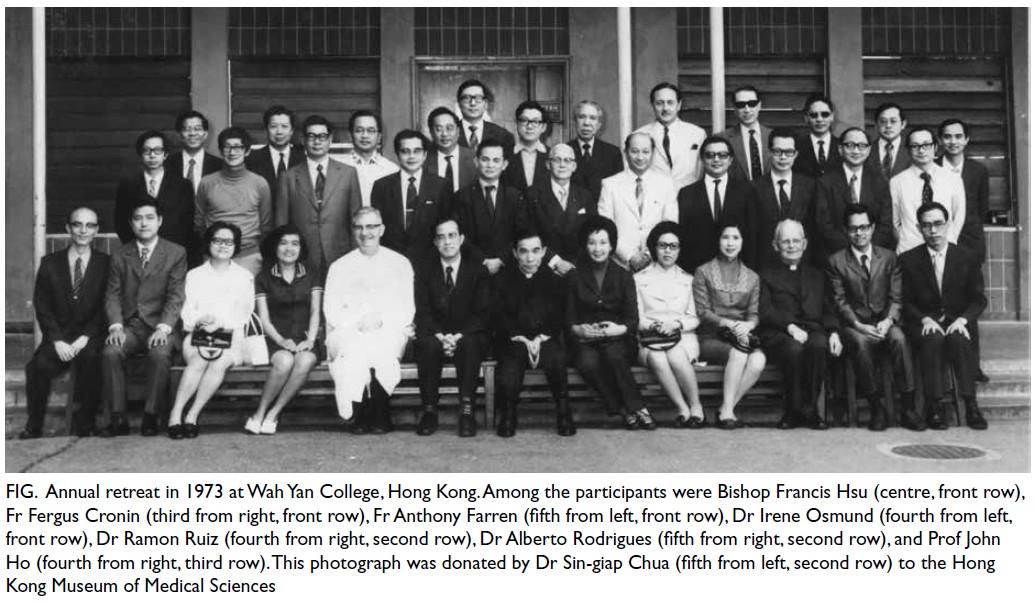
Figure. Annual retreat in 1973 at Wah Yan College, Hong Kong. Among the participants were Bishop Francis Hsu (centre, front row), Fr Fergus Cronin (third from right, front row), Fr Anthony Farren (fifth from left, front row), Dr Irene Osmund (fourth from left, front row), Dr Ramon Ruiz (fourth from right, second row), Dr Alberto Rodrigues (fifth from right, second row), and Prof John Ho (fourth from right, third row). This photograph was donated by Dr Sin-giap Chua (fifth from left, second row) to the Hong Kong Museum of Medical Sciences
Prof Ho is widely respected as Hong Kong’s
Father of Radiology and Oncology and was a
key contributor to the development of oncology services in the city. He also founded the first nongovernmental
organisation for cancer, the Hong
Kong Anti-Cancer Society, and established Nam
Long Hospital, the first hospital in Hong Kong
dedicated to cancer patients and hospice care.
Also present at the 1973 retreat were Dr Ramon
Ruiz and his wife, Dr Irene Osmund, who together
pioneered natural family planning and family life
education in Hong Kong. They helped to found the
Catholic Marriage Advisory Council in 1965 and
devoted their lives to serving the Council.
Such were the good old days, when the post-war
Catholic doctors fostered fraternity through
their shared faith.
References
1. Wong TW, Chan-Yeung MM. Hong Kong Notable Doctors: Individuals Who Shaped the Medical Services, 1842–2015. Hong Kong: The Chinese University of Hong Kong Press; 2025: 264-5.
2. 林榮鈞、張小蘭、劉慶廣。默默無聞的服務:香港天主教診所歷史。香港:香港中文大學天主教研究中心;2023:341。
3. Choa G. The early days of the Guild. In: The Guild of St Luke, St Cosmas and St Damian Hong Kong. 45th Anniversary
1953–1998. 1998. Available from: https://catholicdrhk.wordpress.com/wp-content/uploads/2023/09/45th-anniversary-booklet.pdf. Accessed 14 Jan 2026.
4. Cronin F. The Beginnings of the Hong Kong Guild of St Luke, St Cosmas and St Damian. Newsletter of the Guild of St Luke, St Cosmas and St Damian, Volume 1, No. 1, December 1984.
5. Wong TW, Chan-Yeung MM. Hong Kong Notable Doctors: Individuals Who Shaped the Medical Services, 1842–2015. Hong Kong: The Chinese University of Hong Kong Press; 2025: 274-9.
6. Humphries M. Obituary. Sister Mary Gabriel O’Mahoney. Hong Kong Med J 2006;12:402.
7. O’Mahoney G. A time of transition: Columban sisters in Hong Kong. The Columban Sisters; 2005: 38.
8. Young R. Growing together with the Guild. In: The Guild of St Luke, St Cosmas and St Damian Hong Kong.
45th Anniversary 1953–1998. 1998. Available from: https://catholicdrhk.wordpress.com/wp-content/uploads/2023/09/45th-anniversary-booklet.pdf. Accessed 14 Jan 2026.
9. Fang H. Rehabilitation: A Life’s Work. Hong Kong: Hong Kong University Press; 2002: 70-7.