

© Hong Kong Academy of Medicine. CC BY-NC-ND 4.0
REMINISCENCE: ARTEFACTS FROM THE HONG KONG MUSEUM OF MEDICAL SCIENCES
Training of medical laboratory technicians in
Hong Kong
TW Wong, FHKAM (Emergency Medicine)1; WP Mak, FHKAM (Pathology)2
1 Director, Hong Kong Museum of Medical Sciences Society
2 Chairman, Hong Kong Museum of Medical Sciences Society
 Full paper in PDF
In 1902, after the devastating plague in 1894,
Governor Henry Blake recruited Dr William Hunter
from the UK as the first government bacteriologist.
A purpose-built Bacteriological Institute (BI) was
opened in 1906 under Hunter’s leadership and
investigations to control plague were performed,
including the dissection of dead rats. Initially, Hunter
employed graduates from the Hong Kong College of
Medicine as laboratory assistants. He trained staff
and issued a Certificate of Laboratory Instruction
that was recognised by the Colonial Office and some
British universities.1 Hunter died in 1909 and was
succeeded by Dr Harold MacFarlane in 1910. On the
departure of the last serving graduate from the Hong
Kong College of Medicine, Mr Kwok-tai Leung, a
graduate of Queen’s College, was appointed in 1912
as laboratory assistant.2
When Mr Yan-pui Szeto joined the BI as a
probationary laboratory assistant in 1928, after
graduating from King’s College, he was coached
by Leung who became chief laboratory assistant in
1930. Szeto was promoted to the grade of laboratory
assistant after 2 years of on-the-job training.
According to his Certificate of Competency (Fig 1),
the scope of training included general laboratory
methods, bacteriological, histological and
serological techniques, haematology, parasitology,
vaccine production and examination of water, milk,
ice cream and food products. He continued his work
at the BI during the Japanese Occupation.
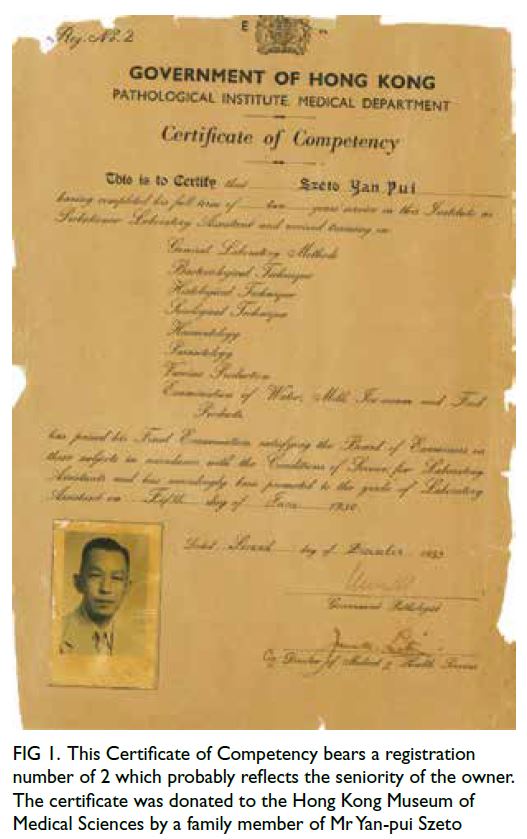
Figure 1. This Certificate of Competency bears a registration number of 2 which probably reflects the seniority of the owner. The certificate was donated to the Hong Kong Museum of Medical Sciences by a family member of Mr Yan-pui Szeto
In 1946, the BI was renamed the Pathological
Institute (PI) with Dr EF Duck as government
pathologist. In the same year Mr AEP Grimmo,
who had worked at the Shanghai Municipal Council
Laboratory for decades, joined the PI as Chief
Technician (Fig 2). Grimmo had been trained at the
Lister Institute of Preventive Medicine at Elstree
near London in the UK.3 He was responsible for
the organisation of more structured training for
laboratory assistants who were required to complete
4 years of training.2 They attended lectures by the
senior medical technologist on different laboratory
disciplines, usually after work, once or twice weekly.
All students rotated through various laboratories
under the supervision of senior staff. After passing a proficiency examination, they would be promoted to
laboratory technician. For further study, they would
need to go overseas. In 1952, Mr Kok-tok Leung, who
had joined the BI 2 years after Szeto, went overseas
for training and obtained the qualification of
Associateship of the Institute of Medical Laboratory
Technology (AIMLT). A regular programme of full-pay
study leave to London for further training and
examination for AIMLT was introduced in 1958.2
From early 1960, the AIMLT qualification became a
pre-requisite for promotion from Medical Laboratory Technician Class I to Medical Technologist. Szeto
was promoted to Medical Technologist in 1961—4
years before his retirement—supported by Grimmo
in recognition of his long and loyal service. Grimmo
also introduced the intermediate examination of the
Institute of Medical Laboratory Technology to Hong
Kong in 1964 which replaced the departmental
examination. When the government pathology
service headquarters were relocated to Sai Ying Pun
Polyclinic in 1960, it also became the main training
site. The Pathological Institute, now known as old
PI, produced vaccines until 1973. Grimmo, who was
instrumental in the introduction of more structured
training and recognition of the medical laboratory
profession, retired in 1965.
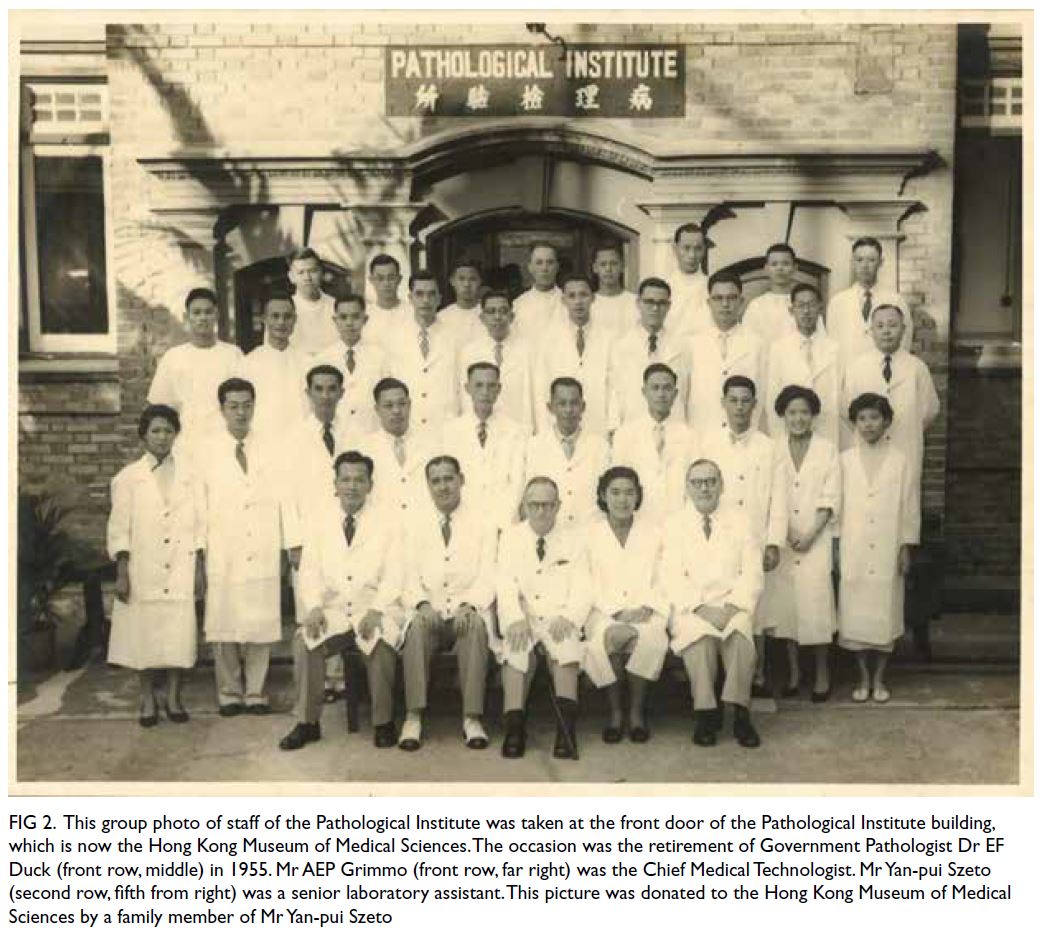
Figure 2. This group photo of staff of the Pathological Institute was taken at the front door of the Pathological Institute building, which is now the Hong Kong Museum of Medical Sciences. The occasion was the retirement of Government Pathologist Dr EF Duck (front row, middle) in 1955. Mr AEP Grimmo (front row, far right) was the Chief Medical Technologist. Mr Yan-pui Szeto (second row, fifth from right) was a senior laboratory assistant. This picture was donated to the Hong Kong Museum of Medical Sciences by a family member of Mr Yan-pui Szeto
In 1963, Professor James Gibson joined The
University of Hong Kong as head of the Department
of Pathology. He also chaired the Management
Committee of Extramural Studies of the University.
He introduced courses for medical laboratory
technicians based on similar courses in Scotland.4 The Department of Extramural Studies introduced
the Ordinary Certificate in Medical Laboratory
Technology course and the Higher Certificate in
Medical Laboratory Technology course in the
early 1970s. These were 2-year part-time courses
targeting laboratory workers at university and
government hospital laboratories. The courses had
four main modules covering Clinical Biochemistry,
Medical Microbiology, Haematology and Serology,
and Histopathology and Cytology. The Ordinary
Certificate course was later discontinued and the
Higher Certificate course renamed Higher Certificate
in Medical Laboratory Science.5 The certificate was
recognised as being equivalent to the AIMLT.
The Hong Kong Polytechnic offered a 2-year
Diploma course in 1978. The first students graduated
in 1980. All graduates were recruited by the Medical
and Health Department as Medical Laboratory
Technician II. The Diploma course was upgraded
to a Higher Diploma in 1983. It was replaced by a
Bachelor’s degree course when the Polytechnic became a university in 1994. In the 1980s, several
Senior Medical Technologist (Training) posts were
established within the PI. Their main duties were
to liaise with the Senior Lecturer/Lecturer of the
Polytechnic to arrange field training of students,
one of the requirements of the course. These local
courses and qualifications provided the basis for the
introduction of local laws to regulate the profession.
The Hong Kong Government enacted the
Supplementary Medical Professions Ordinance
(Cap 359) in 1980 to regulate the registration of
allied health professionals including laboratory
technicians. The Ordinance was renamed the Allied
Health Professions Ordinance on 25 July 2025, to
better reflect the professions’ roles and status.6 The
Medical Laboratory Technologists (Registration and Disciplinary Procedure) Regulations under Chapter
359A of the Laws of Hong Kong were introduced with
the registration of medical laboratory technologists
commencing on 1 October 1990, and disciplinary
control of the profession effective from 1 August
1991. These regulations are subsidiary legislation
under the Supplementary Medical Professions
Ordinance.7 Formal qualifications approved by the
Medical Laboratory Technologists Board are now
required for registration and practice.8
Acknowledgement
The authors acknowledge the kind assistance of Mr Peter
Hon who joined the Pathological Institute in the 1960s. He
provided the authors with valuable first-hand knowledge of
training at the Pathological Institute during the post-war era.
References
1. Wong TW, Chan-Yeung MM. Hong Kong Notable Doctors: Individuals Who Shaped the Medical Services 1842-2015. Hong Kong: The Chinese University of Hong Kong Press; 2025: 26-30.
2. Ho FC. The Silent Protector—Hong Kong’s Bacteriological Institute, its History and Legacy. Hong Kong: Hong Kong
Museum of Medical Sciences; 2020: 83-7.
3. MacKay J. Smallpox vaccine in Hong Kong. Synapse 2002 April: 26-7. Available from: https://www.hkcp.org/docs/Synapse/synapse200204.pdf. Accessed 21 Nov 2025.
4. Wong TW, Chan-Yeung M. Hong Kong Notable Doctors—Individuals Who Shaped the Medical Services 1842-2015. Hong Kong: The Chinese University of Hong Kong Press; 2025: 200-3. Crossref
5. 馮小娟, 何敏盈. 《活學空間60載—HKU SPACE 校友的見證》. 香港: 香港大學專業進修學院; 2017: 198-201.
6. Legislative Council, Hong Kong SAR Government. Supplementary Medical Professions (Amendment) Ordinance
2025. Available from: https://www.legco.gov.hk/yr2025/english/ord/2025ord033-e.pdf. Accessed 4 Dec 2025.
7. Hong Kong SAR Government. Medical Laboratory Technologists (Registration and Disciplinary Procedure)
Regulations (Cap 359A). Available from: https://www.elegislation.gov.hk/hk/cap359A. Accessed 27 Aug 2025.
8. Medical Laboratory Technologists Board. Registration. Qualifications for registration. Available from: https://www.smp-council.org.hk/mlt/en/content.php?page=reg_quareg. Accessed 27 Aug 2025.